If you’ve ever seen a roadside traffic stop in a movie or real life, chances are you’ve witnessed a driver asked to perform a few physical and mental tasks. These aren’t random exercises—they are standardized procedures used by law enforcement to assess impairment.
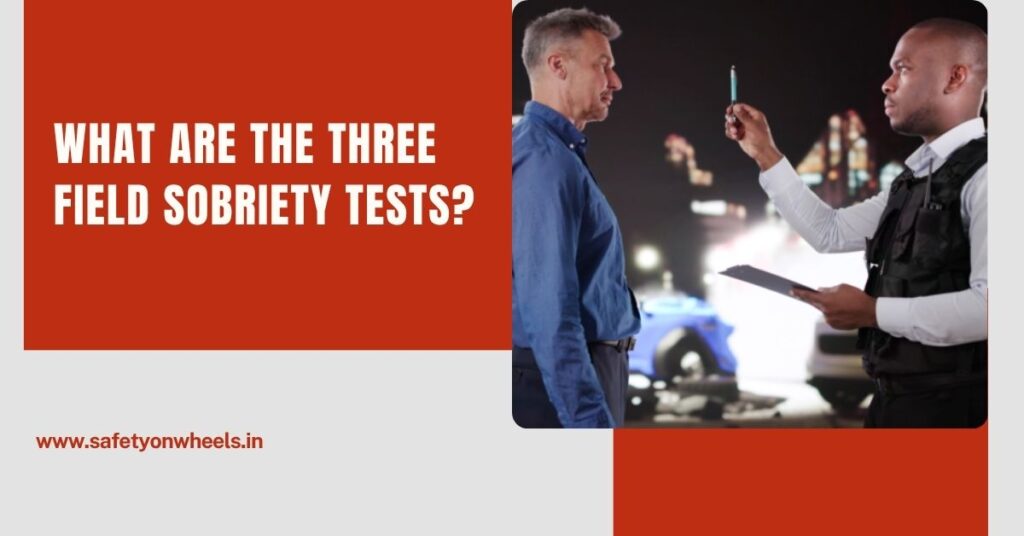
This brings us to an important question many drivers ask: what are the three field sobriety tests?
Understanding these tests is not just useful for legal awareness—it also helps you appreciate how impairment affects driving ability and why these evaluations matter for road safety.
In this guide, we’ll break down the three standardized field sobriety tests, explain how they work, what officers look for, and why they are considered reliable tools in detecting impaired driving.
What Are the Three Field Sobriety Tests?
The three standardized field sobriety tests are:
- Horizontal Gaze Nystagmus (HGN) Test
- Walk-and-Turn (WAT) Test
- One-Leg Stand (OLS) Test
These tests are designed to evaluate balance, coordination, attention, and eye movement, all of which are affected by alcohol or drug impairment.
Law enforcement officers use them as part of a structured assessment to determine whether a driver may be under the influence.
Also read: When Does the Law Require Your Headlights to Be Turned On?
Why Field Sobriety Tests Are Used?
Before diving into each test, it’s important to understand their purpose.
Detecting Impairment Beyond Appearance
Not all signs of impairment are obvious. A driver may appear calm or composed but still have reduced reaction time or coordination.
Field sobriety tests help officers:
- Assess physical and cognitive function
- Identify subtle signs of impairment
- Make informed decisions about further testing
Supporting Legal Evidence
These tests provide observable, documented evidence that can support:
- Arrest decisions
- Further chemical testing (breath or blood tests)
Standardization and Reliability
The three tests are standardized to ensure:
- Consistency across evaluations
- Fairness in assessment
- Reliable indicators of impairment
Horizontal Gaze Nystagmus (HGN) Test
The HGN test focuses on eye movement, which can reveal impairment that is not visible through general observation.
What Is Nystagmus?
Nystagmus is an involuntary jerking of the eye that becomes more pronounced under the influence of alcohol or certain drugs.
How the Test Is Conducted
An officer will:
- Ask you to follow an object (such as a pen or flashlight) with your eyes
- Move the object side to side
- Observe how your eyes track the movement
What Officers Look For
Officers check for:
- Lack of smooth eye movement
- Distinct jerking at certain angles
- Early onset of nystagmus
Why This Test Is Effective
The HGN test is considered highly reliable because:
- Eye movement is difficult to control consciously
- Impairment affects it consistently
Walk-and-Turn (WAT) Test
The walk-and-turn test evaluates both physical coordination and mental focus.
How the Test Works
You are asked to:
- Take a series of steps in a straight line
- Turn in a specific manner
- Walk back the same way
Instructions Typically Include
- Heel-to-toe walking
- Keeping arms at your sides
- Counting steps aloud
What Officers Observe
Officers look for signs such as:
- Losing balance
- Starting before instructions are complete
- Missing heel-to-toe contact
- Stepping off the line
- Incorrect turning
Why This Test Matters
This test divides attention between:
- Physical movement
- Mental tasks
Impairment makes it difficult to manage both simultaneously.
One-Leg Stand (OLS) Test
The one-leg stand test focuses on balance and concentration.
How the Test Is Performed
You are asked to:
- Stand on one leg
- Raise the other leg slightly off the ground
- Count aloud for a specified period
What Officers Look For
Indicators of impairment include:
- Swaying while balancing
- Using arms for support
- Hopping to maintain balance
- Putting the foot down early
Why Balance Is Important
Maintaining balance requires:
- Coordination
- Muscle control
- Focus
All of these can be affected by alcohol or drugs.
How Accurate Are These Tests?
Field sobriety tests are widely used because of their proven effectiveness.
Scientific Validation
Research has shown that when administered correctly:
- The combination of these tests provides a strong indication of impairment
- Accuracy improves when multiple tests are used together
Limitations to Consider
While reliable, these tests are not perfect. Factors that may affect performance include:
- Medical conditions
- Fatigue
- Nervousness
- Uneven surfaces
This is why they are often followed by chemical testing.
Common Misconceptions About Field Sobriety Tests
There are several misunderstandings surrounding these tests.
“They Are Just Guesswork”
In reality, these tests are based on standardized procedures and scientific research.
“Only Drunk Drivers Fail”
Even sober individuals can struggle under certain conditions, which is why results are evaluated carefully.
“They Are Optional Everywhere”
Rules vary by region, but refusing tests can have legal consequences in many jurisdictions.
The Role of Field Sobriety Tests in Road Safety
These tests are not just about enforcement—they play a crucial role in preventing accidents.
Reducing Impaired Driving
By identifying impaired drivers early:
- Potential accidents can be prevented
- Roads become safer for everyone
Raising Awareness
Knowing about these tests encourages drivers to:
- Avoid driving under the influence
- Make safer decisions
Supporting Law Enforcement
These tools help officers:
- Act quickly and effectively
- Maintain public safety
Practical Advice for Drivers
Understanding these tests can help you stay informed and prepared.
Avoid Driving Under the Influence
This is the most effective way to avoid any issues related to sobriety testing.
Stay Calm During Interactions
If stopped:
- Listen carefully to instructions
- Follow them clearly
Be Aware of Your Condition
Fatigue, illness, or stress can affect coordination. Always assess your ability to drive safely.
The Bigger Picture: Responsibility on the Road
Driving is a responsibility that requires:
- Focus
- Coordination
- Sound judgment
Field sobriety tests highlight how easily these abilities can be impaired.
By understanding how these tests work, you gain a deeper appreciation for:
- Safe driving practices
- The importance of staying alert and unimpaired
Also read: Choose 3 Qualities That a Successful Family Show Needs to Have.
Final Thoughts
So, what are the three field sobriety tests? They are the Horizontal Gaze Nystagmus, Walk-and-Turn, and One-Leg Stand tests—each designed to evaluate different aspects of a driver’s physical and mental ability.
Together, they provide a structured and effective way to detect impairment and improve road safety.
While most drivers will never need to perform these tests, understanding them reinforces an essential principle: safe driving starts with being fully in control—both mentally and physically.